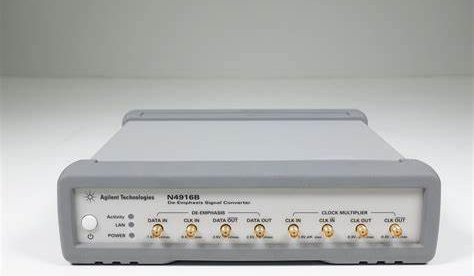
Product Description:
The N4916B can use one pre-cursor and two post-cursor emulated transmitters to de-accentuate and independently adjust de-accentuate levels up to 12.0 dB. Through DC coupling, it can tolerate the unbalanced code flow that often occurs in the training sequence. When excitation is performed using jitter on the data and clock signals, the N4916B has no effect on jitter and can simulate the real aggravation and jitter conditions that the receiver is expected to tolerate. Deweighting also compensates for distortion caused by the cable, fixture or test circuit board in the tester, resulting in more accurate device characterization results.
De-accentuating technology is suitable for use in the transmission of digital electrical signals at gigabit data rates. Deweighting is a signal predistortion designed to compensate for the degradation of signal quality caused by transmitting electrical signals at gigabit rates over PC circuit board tracks, backplanes, or long cables. Given that the next generation of serial bus standards will exceed 5 Gb/s in speed, engineers will need to perform complex de-accentuating and multi-tap finite impulse response (FIR) filtering.
Features:
A front cursor and two 0 to 12 dB rear cursors are adjustable to de-accentuate
Supports data rates from 660 Mb/s to 14.2 Gb/s
Tolerate unbalanced patterns
Transparent to jitter
Flexible as a front end for J-BERT N4903B, ParBERT 81250A or other pattern generators
Optional clock multiplier (Option 001)
Small size
It can be programmed with the J-BERT N4903B or independently