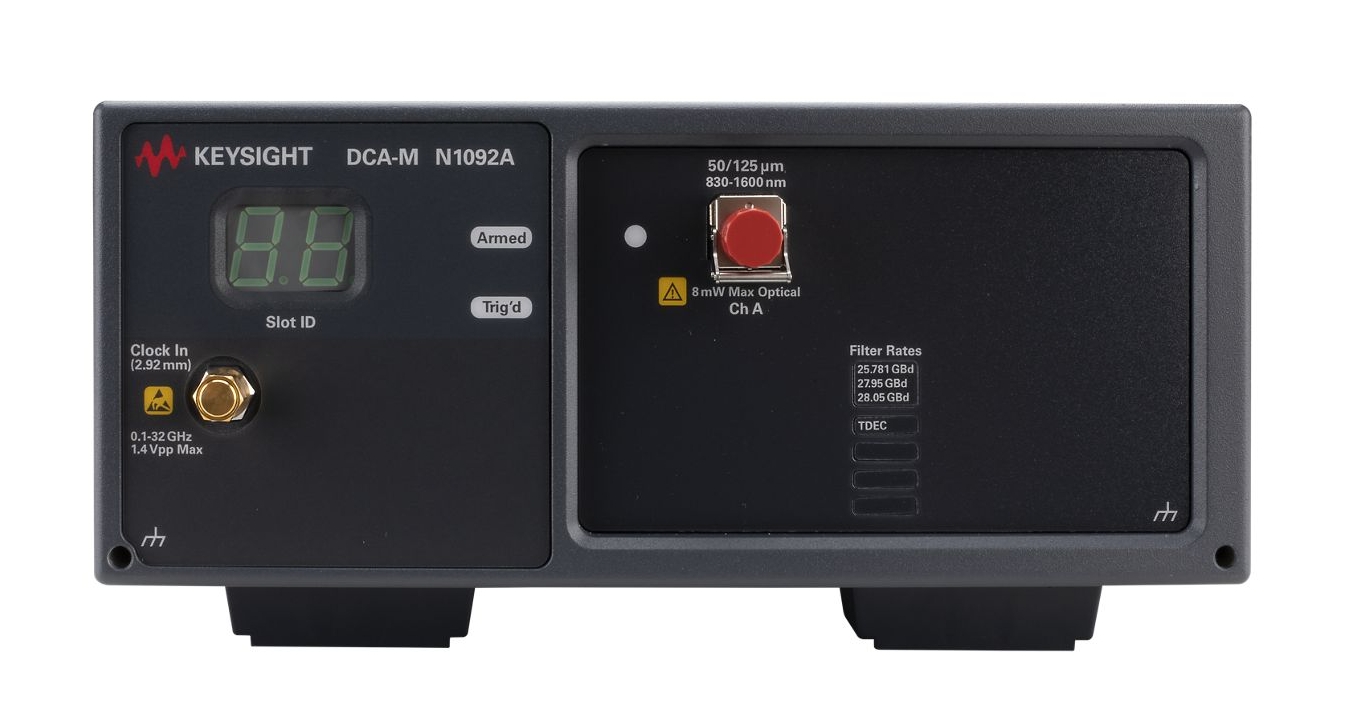
The Keysight N1092 Sampling Oscilloscope is an outstanding device in the field of optical waveform analysis. It is meticulously designed to meet the needs of the rapidly developing communication technologies and the increasingly complex electronic signal testing requirements. With its remarkable advantages of high accuracy and low cost, it has become a reliable assistant for numerous engineers and researchers in the detection and analysis of optical signals. It can provide solutions ranging from 8.4 to 64 Gbaud, facilitating technological breakthroughs and innovations in key fields such as optical communication and high - speed digital signal processing across various industries.
High Sensitivity and Low Noise Characteristics: It has excellent signal detection capabilities, with an extremely low background noise of only 5 μW during optical signal detection. This enables it to precisely capture extremely weak optical signals, ensuring that signals will not be lost or misjudged due to noise interference even in complex electromagnetic environments. It provides a solid foundation for the accurate analysis of optical signals and performs remarkably well in scenarios such as long - distance optical communication link testing and weak optical signal sensing applications.
Ultra - Fast Throughput and Efficient Testing: With a sampling rate of up to 250 kHz, it can quickly collect signals and achieve ultra - fast throughput. Whether it is a continuous high - speed data stream or signal features that appear instantaneously, it can respond rapidly and capture them accurately. In automated testing systems and large - scale production testing scenarios, it significantly shortens the testing time, improves testing efficiency, helps enterprises effectively save time costs, and enhances overall production efficiency.
Precise Analysis and Extremely Low Jitter: In terms of high - speed data analysis, the jitter is less than 200 fs. This performance enables it to precisely measure and analyze various key parameters of high - speed optical communication signals and high - frequency digital signals. Engineers can accurately evaluate signal quality, timing, and other aspects based on the precise data it provides, offering powerful data support for product research and development, fault troubleshooting, and other tasks. It contributes to optimizing the performance of electronic devices in high - speed data transmission and processing.
Wide Bandwidth and Adaptability to Diverse Testing: It has excellent bandwidth performance, with an unfiltered bandwidth of more than 40 GHz (Option 40A), and can measure various signals from low frequencies to high frequencies. This wide bandwidth characteristic allows it to be widely applied in multiple fields such as communication, computer, and consumer electronics, meeting the testing requirements of different types of electronic devices. It provides a one - stop solution for diverse testing tasks, avoiding the inconvenience of frequently changing equipment due to bandwidth limitations of the equipment.
Compact Design and Portable Usability: It adopts a compact design, with a small and lightweight appearance, making it more portable and easier to move compared to traditional oscilloscopes. It is not only suitable for laboratory environments but also can be flexibly applied in scenarios such as on - site testing and outdoor inspections. Meanwhile, its operation interface is simple and intuitive, easy to get started with. Even first - time users can quickly familiarize themselves with and master the operation method, effectively improving the usability and popularity of the device.
Integrated Clock Recovery and Powerful Functions: It provides a comprehensive clock recovery function (Option CDR). When processing optical signals, it can accurately recover the clock signal from the received signals. This function is crucial for the analysis of optical signals in the field of optical communication. By recovering the clock signal, the N1092 can sample and analyze the signals more accurately, effectively solving the problem of signal analysis errors caused by clock asynchrony, and providing indispensable technical support for the research, development, debugging, and maintenance of optical communication systems.