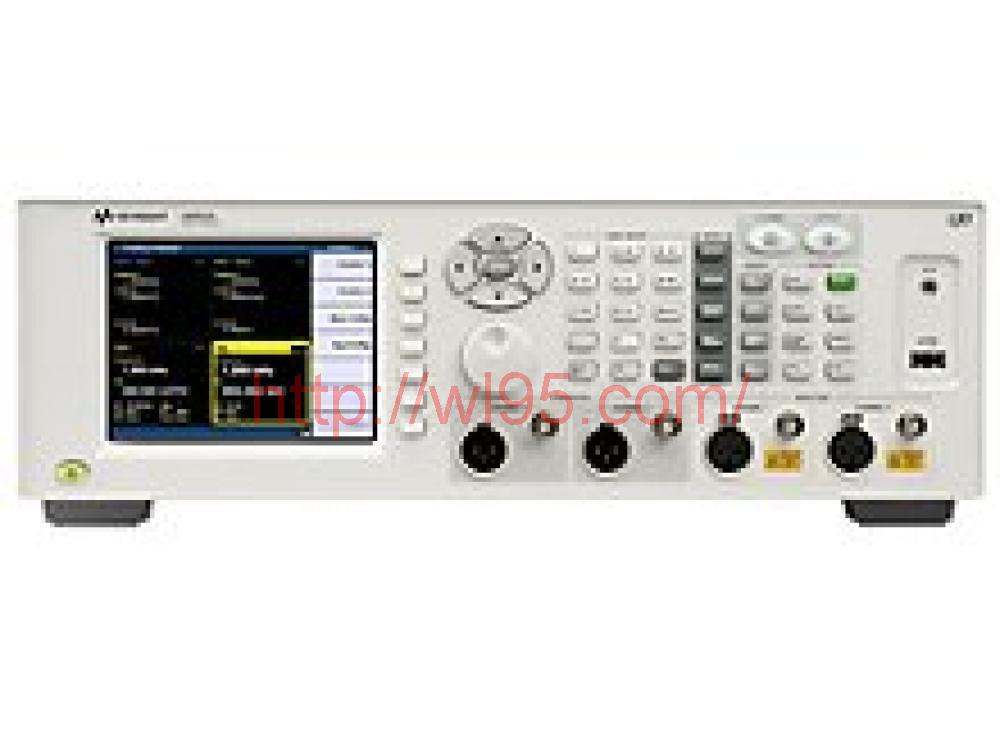
Product Description:
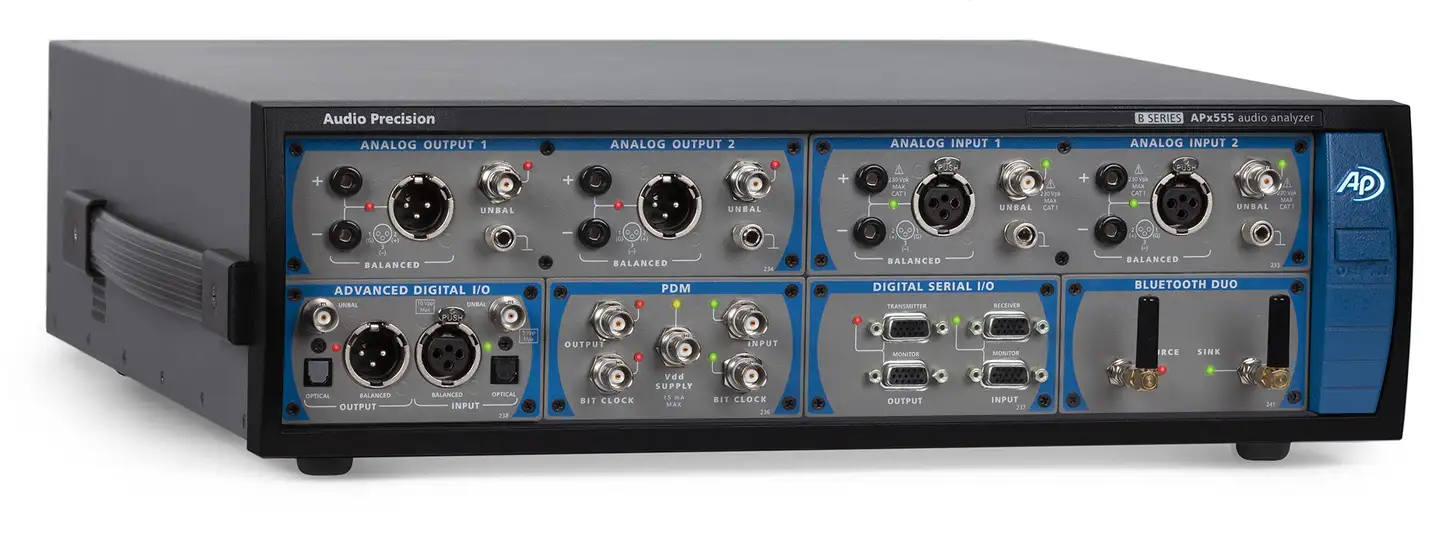
The APX555B is a test device with 30 years of experience, a two-channel audio analyzer that requires no compromise. R&d engineers and production technicians need the highest performance, a wide range of digital I/O options and fast, intuitive software, and the APx555 is the new standard for audio analyzers.
With a typical residual THD + N of -120dB and over 1 MHz bandwidth, the APx555 exceeds the analog performance of all other audio analyzers, including a 5 dB improvement over the 2700 series analyzers. Add to that 1.2 million point FFT and full 24-bit resolution, and your performance is unmatched by any other instrument.
The APx555 features two balanced and two unbalanced analog inputs and outputs, as well as 216k digital inputs and outputs via AES/EBU, TOSLINK, and SPDIF. In addition, I/O can be extended using optional digital serial, HDMI with ARC, PDM and Bluetooth modules. The new Advanced Master Clock (AMC) module handles input and output clock signals to synchronize the APx555 with external devices (or vice versa), and the AMC can also generate jitter and analysis. The AMC comes standard with the APx555 and is the audio analyzer of choice for the APx52x series and APx58x series.
Features:
Conversion function
APx500 software version 5.0 adds the ability to measure the transfer function of electronic audio and electroacoustic devices. Transmission function measurement provides the device with sophisticated frequency response capabilities, including the amplitude and phase (or real and virtual components) of any wideband signal used. This feature is a powerful complement to the sequential mode of the apx software, allowing any AP analyzer to be used as a multi-channel dynamic signal analyzer or so-called dual-channel analyzer
Open-Loop Chirp
Version v4.6, the APx500 software can now perform open-loop measurements using log-scanned sine (i.e., jitter) test signals. This signal provides multiple high-resolution results in a very short period of time, and now APx users can use these buzzes in test scenarios where the signal may come from or terminate, as a file on the device under test (dut) or a server connected to the dut. This new feature is particularly helpful for those developing smart devices (e.g.
Jitter analysis
Jitter in digital audio systems can cause audible distortion in the form of jitter sideband in the output signal. Jitter tolerance testing can reveal the distortion caused by jitter, but it is often neglected in circuit and component design due to its difficulty and time consuming. The Audio Accuracy ap analyzer provides jitter generation and jitter analysis to simplify jitter testing.
No code automation and full API
The APx500 measurement software is available as a technologically advanced audio measurement interface. Complex procedures with user prompts, restrictions, and external application calls can be created directly in the gui, saving time and money while ensuring painless updates over time because no development is required.
Create custom interfaces and application-to-application automation with the comprehensive apx api. Extensive documentation and examples are provided for visual basic.NET, C#, MATLAB, LabVIEW, and Python. Projects and automation can be shared with other apx units anywhere in the world.
Universal software platform
From a practical point of view, the apx audio analyzer uses a common software platform that makes testing and results easier to share. All Settings for testing are saved in one project file, so test Settings can be easily copied between rd and production facilities anywhere in the world. Project files are compatible with B-Series and traditional apx instruments, and each project is self-contained, so you never have to worry about dependencies or broken links. Users can even embed waveform files and images in project files.
To share measurement results with customers, contract manufacturers, or management, apx automatically generates rich graphical reports with delivery/failure limits and options to export as pdf, html, excel, csv, rtf, or matlab files.