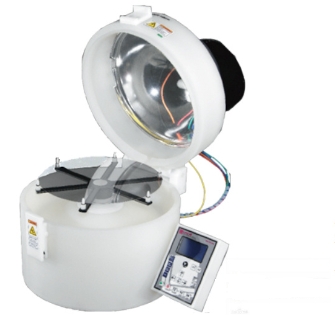
First, wet corrosion machine use and characteristics:
1, use: mainly used in micro-machining, semiconductor, microelectronics, optoelectronics and nanotechnology processes in silicon, ceramic wafer development, wet corrosion, cleaning, washing, drying and photolithography, baking and other equipment used. The equipment can meet the substrate processing requirements of various sizes below, and formulate the corresponding pallet fixtures.
2, wet corrosion machine features:
(1) The appearance is clean and beautiful, the floor area is small, and the use area of the ultra-clean room is saved;
(2) VoD top valve control technology to avoid secondary pollution;
(3) Independent reagent supply pipeline for developing etching fluid;
(4) Precise control of differential pressure in the processing chamber;
(5) Meet the anti-corrosion tray of 2 inches to 8 inches;
(6) reagent injection Angle can be adjusted;
(7) Unique design of "cavity washing" structure to ensure "dry in dry out";
(8) Wet corrosion machine with high performance, low failure rate, long service life, easy operation and maintenance, beautiful appearance, complete after-sales service.
Second, the working principle:
The development system has a programmable valve that allows single-syringe reagent drops to be repeated as required by etching, developing and cleaning applications, such as rinsing (usually with deionized water or solvents) followed by drying (usually with nitrogen) and other final processing steps. Wafers and pipes with this sequential valve technology open and close the process in a completely dry environment. Isolated and separate feedwater units can be in a static position and can be adjusted under the cover. The homogeneity developer also has selectable dynamic linear or radial drip characteristics.
Applicable process (including but not limited to the following wet process)
Photoresist development (KrF/ArF)
SU8 thick adhesive development
Clean after development
PostCMP cleaning
Remove glue and clean the cover
Photoresist removal
Metal Lift-off treatment
Etching micro etching treatment
Four, the main technical parameters:
1. System Overview
1.1 Intelligent locking, the system cover plate has an intelligent locking device to ensure safe operation;
1.2 Protective gas, CDA (clean and dry gas)/nitrogen (N2), pressure 60~70PSI;
1.3 Communication interface, Bluetooth connection;
2. Substrate and processing method
2.1 The size of the substrate meets the base material within 200mm diameter;
2.2 Substrate processing mode, manually download;
3. Control system
3.1 User interface, 650 high-precision digital display screen/Windows-based SPIN3000 operating software;
3.2 Maximum 20 program segments can be stored;
3.3 Maximum 51 process steps;
3.4 Time setting range, 0.1S~ 99min 59.9s (minimum increment 0.1S);
3.5 Maximum rotation speed, 3,000 rpm, ±0.5 rpm (with safety cover);
3.6 Motor acceleration, 1-12,000 rpm/s;
4. Reagent distribution system
4.1 Distribution of chemical reagents
4.1.1 A Standard chamber Bowl Wash 1 channel pure water and 1 channel nitrogen;
4.1.2 B Back Cleaning Back Riser Riser 1 Pure water.
4.1.3 Sample C was washed and dried with 1 channel of pure water and 1 channel of nitrogen;
4.1.4D Custom chemical reagents can be accessed at the same time (several liquids can be selected according to the user's application) custom chemical reagents (developer/corrosion solution/other cleaning solution);
4.2 Reagent supply method
* 4.2.1A system pure water and nitrogen and compressed gas (nitrogen can be substituted) are supplied by the laboratory;
4.2.2B Custom chemical reagents are supplied by pneumatic pump BP and pressure vessel;
4.3 The injection device adopts the special nozzle in the pool with the original imported fog from Japan;